

Starting afresh: Our first 'This Might Work' experiment🎙️
A small, slightly eccentric writing experiment from Oliver Burkeman and what happened when a real writer tried it


Hi writing friends Bec here,
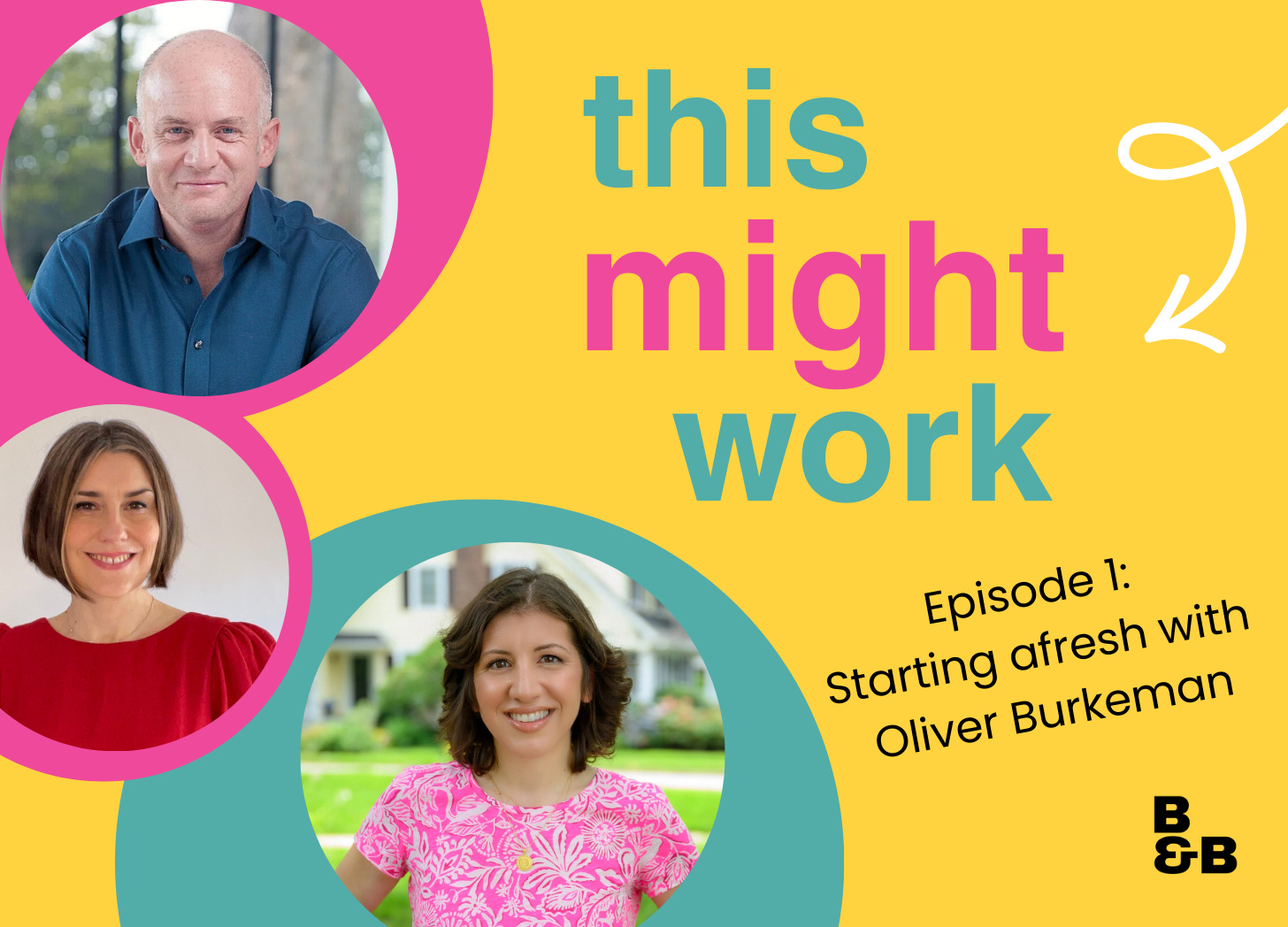
A little bonus post today to mark the launch of something new we’ve been quietly creating: This Might Work, our prototype audio series where we test small writing experiments in real time.
Each episode takes one practical tip from a writer we admire, tries it out with a real writer working on a real project, and reports back on what happened - the successes, the surprises and the awkward bits. It’s a way for us to explore writing advice in practice, not in theory, and to see if it might work.
Our first guest is the bestselling author of Four Thousand Weeks, Oliver Burkeman, and the tip he shared is simple, ‘massively eccentric’ (his words not mine), and surprisingly effective.
The tip: ‘starting afresh’
Oliver’s method is this: print out a section of your draft - no more than a thousand words - delete it from your document - and then type it all back in from the paper.
Yes, really. 😬
As Oliver explains:
“When I type it back in, I make all sorts of changes. They come very easily and naturally… Typing it back in is just admin work… You need to give yourself the feeling that you’re starting afresh, except this time you have the whole thing printed out.”
Oliver Burkeman
It’s not about drama or masochism. It doesn’t deny the genuine fears you have about your writing. And it’s certainly not about positive thinking. It’s about tricking yourself that it is just admin. Retyping frees you from the weight of the existing draft - the one you keep tinkering with even though something deeper needs to change.
Matt Bell puts it even more starkly in Refuse to Be Done:
“It is the most necessary and productive thing I do.
Whatever you do, don’t cut and paste to save time.
Instead retype everything.
Yes, everything.”
Matt Bell
And there’s a long tradition of writers accidentally discovering the same thing. Jilly Cooper famously lost the only copy of her typed manuscript on the number 22 bus in the 1970s, abandoned the whole thing for years, then rewrote it entirely from scratch. The result became Riders. Looking back she said:
“I hate to be conceited, but I think it’s probably one of the best books I ever wrote…”
Jilly Cooper
Sometimes letting go of the draft you have is what allows the book you’re really writing to reveal itself.
Elizabeth tries it out
To see how this works in practice, we asked writer and literacy educator Elizabeth Morphis to test Oliver’s method while revising the introduction to her book for parents.
She approached it with admirable commitment:
printed the section she needed
opened a new document
moved the original draft to a different folder
and refused to copy and paste, even when tired, tempted or cramped on a plane
She tried the method on a family trip - the aeroplane, the hotel roof at 3 a.m., and finally another flight from Athens to Paris. And crucially: she never opened the original document.
The result?
“I totally would’ve copied and pasted… and then it would’ve stayed on that superficial layer… Sometimes it was uncomfortable, but I do feel like it was better.”
Elizabeth Morphis
That’s the heart of it. Starting afresh slows you down just enough to see what the writing actually wants to be - not what it used to be, and not what’s easiest to salvage.
Elizabeth found the process tiring at moments, but the new version felt more alive. And she finished the revised introduction.
Why this works
Retyping breaks the spell of the existing draft. It forces you to re-articulate the idea rather than move words in an existing sentence. It invites new thinking and it removes the safety net of ‘good enough’.
And in an era where everything can be duplicated endlessly with a click, there’s value in a method that requires time, intention and attention. Not as punishment, but as a way to discover what your writing is actually trying to say.
Listen or read
👂 You can listen to the full episode here. ⬇️ ⬇️
👀 And read the full transcript here. ⬇️ ⬇️

If you decide to try the tip yourself, choose a small section, print it out, and type it back into a clean document. Deleting the original is optional - the feeling of starting afresh is what matters.
Let me know how you get on, I’d love to know.
Bec
Quick favour before you go…
This Might Work is a prototype podcast. This is the first episode, with several more recorded but not yet edited. If you like it, please let me know. Making a series will take time and money, which I can’t afford right now, if there is interest, I can explore sponsorship and funding options.
Credits
Presenter: Bec Evans
Featuring: Oliver Burkeman and Elizabeth Morphis
Extracts from Matt Bell Refuse To Be Done and Elizabeth Day’s interview with Jilly Cooper where she talks about Riders.
Producers: Bec Evans and Chris Smith of Breakthroughs & Blocks
Podcast production: Suzi Dale, Story Publishing
With gratitude ❤️
Huge thanks to writer and broadcaster, Oliver Burkeman and our brave tester Elizabeth Morphis who is an associate professor of childhood education and literacy, and founder of The Literacy Teacher’s Life.

I am going to try this, this morning. First day of the month, new notebook, new energy. I have printed out a couple of sections that I have tagged #Complete rewrite in my edit. I will read and rewrite by hand in my Notebook, as the first day of my writing sprint. I'll let you know how I get on.
I read your script, Bec, because I find that when listening to something it does not go at the right speed for me - I vary between 'oh, do hurry up' and 'what was that you just said' and replay the tape. This might be a factor of how I was educated before computers, even before any sound recordings other that huge great heavy records - not even viynl!
Standing back from it, I understand my method to be as follows:
write in long hand, transpose onto computer making alterations as I go (learnt to touch type on an upright Imperial typewriter - not even a golf ball electric!) print out - leave a for w hile - anything up to a month, scrutinise, alter again, print out again and call it second draft!