

Episode1: This Might Work - full transcript
Starting Afresh With Oliver Burkeman


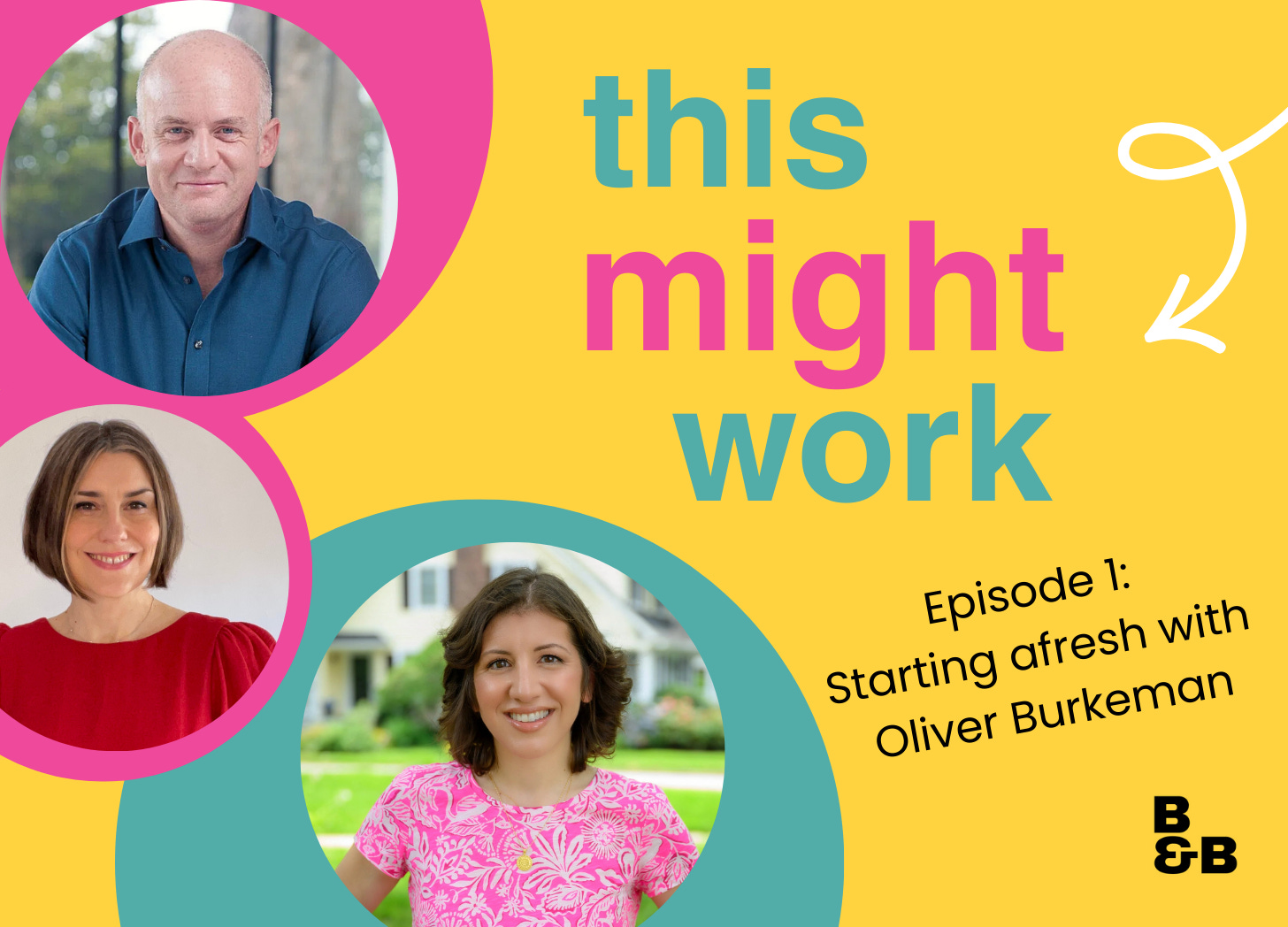
Bec Evans
Oliver Burkeman writes a newsletter called the Imperfectionist, which is lucky because most people who write spend far too long trying to make everything perfect before it’s ready. Today he shares a simple technique to help you start afresh and see your work with clearer eyes. And we are giving it a go.
This is, This Might Work where each episode explores one small writing experiment you can try yourself. I’m Bec Evans. I’ve worked with thousands of writers and I know how easily perfectionism can stall a project before it’s even begun. You’ll hear Oliver describe the method. Then we follow our tester, Elizabeth, as she uses it while revising her book. I’ll also share some insights into why this approach works.
Let’s get started. I asked Oliver Burkeman what’s working for him right now in his own writing. He told me about this technique. Simple, a bit eccentric and surprisingly effective. Here he is.
Oliver Burkeman
[01:04] A technique that I find incredibly helpful, although I’m a bit worried that it strikes most people as massively eccentric, is that when I’m working on a piece of writing, I go through multiple cycles of printing out the section that I’m working on, deleting it from the file that I wrote it in and typing it back in from the paper onto the computer.
So, if I’m writing an email newsletter, I would do this with the whole newsletter. If I was writing in the book context, it would probably be a subsection of a chapter. It’s certainly not thousands and thousands of words at once.
Basically what happens is when I type it back in, I make all sorts of changes. They come very easily and naturally and I think they are better than if I was just to sort of look at the document in either medium and just sort of try to fiddle with it or put notes on it or highlight bits or something like that.
[02:02] So I know this strikes some people as an arduous idea, but to me it’s the exact opposite, right? It’s like: I’ve written this thing, I’m not happy with it yet. I print it out, I type back in. Typing it back in is just admin work, right? It doesn’t tax my soul in some terrible pretentious writer way. It’s just typing it back in.
You need to give yourself the feeling that you’re starting afresh, except this time you have the whole thing printed out. It’s just such a luxury. It feels great. It’s like, oh, I’m starting afresh. Only this time. I don’t need to start afresh.
Bec Evans
[02:38] Did you catch that? He deletes the original. I gasped when he said, almost spat out my tea. It taps into something deeper than the technique itself. That fear of losing the only version. But this is where things get interesting for our tester, writer and literacy educator, Elizabeth Morphis.
Elizabeth Morphis
[03:00] So I’m in my home office here on Long Island, about 30 minutes outside of New York City. My primary professional role is a professor of childhood literacy. So I primarily work with students who are practicing teachers and they’re returning to school for their master’s degree and a literacy certification.
So before this, the majority of my writing has been for academic journals to earn tenure, but right now I’m working on a book project for parents. So not academic, but more parent focused so that they can support their children with reading. Because this has become an issue with all the research that has been coming out about reading recently and how kids are not reading. Parents always hear from teachers you should be reading, but what does that mean and how can they support their kids?
Bec Evans
It’s such a great book and I need to offer congratulations that you’ve finished your first draft.
Elizabeth Morphis
[04:00] I did, yes. Thank you. <Laugh>.
Bec Evans
I have got a tip from Oliver Burkeman. He calls it his starting afresh approach and he does this across all his books and articles and what he does is he prints out a section of that book, no more than a thousand words and then he retypes it afresh. So new document. Working from the print out. So no copying and pasting and no tinkering with the original words.
And he also has a rather scary approach where he deletes the original file.
Elizabeth Morphis
Oh my gosh, seriously?
Bec Evans
Yes! We don’t need to go that far, but I think focusing on typing from scratch and getting that sense of a fresh perspective on your text. How does that make you feel?
Elizabeth Morphis
[04.55] I actually think that makes me feel better because then sometimes I get stuck in: ‘I have this, I should use it’. Or you know, as you said, the copy and paste. So I actually think that’s a nice way. I think that’s a good approach for this rewrite.
Bec Evans
Perfect. Well I’m going to let you go off and start retyping and I’d love to hear how you get on.
Elizabeth Morphis
That’s perfect. Thank you so much.
Bec Evans
While we leave Elizabeth to work on her second draft, let’s see how other writers use this technique. Retyping from scratch is something I struggle with.
[05:30] I’m a tinkerer by nature and like to rework the draft I’m in. But in his book, Refuse To Be Done, Matt Bell makes a strong case for retyping. He says
“It is the most necessary and productive thing I do. I retype my second draft from scratch.”
He offers this advice:
“Whatever you do, don’t cut and paste to save time.
Instead retype everything.
Yes, everything.”
His point is that rewriting from the beginning frees you from the sentences you wrote before you knew what the book was. The technique captures the magic of the original writing, but with the wisdom of experience.
Bell says: “when in doubt, rewrite instead of revise.” It might feel unbearable to retype a sentence that sucks, but that discomfort will help you improve it. This approach isn’t easy and it will take time.
[06:30] As Bell says: “The book you’re writing becomes the book. It wants to be uniquely itself, fully alive.”
This isn’t a productivity hack. It takes time, effort, and commitment. But slowing down and paying attention will improve your writing in ways that quick fixes never can. Every draft is part of learning your craft. That’s the theory.
But what does it feel like in practice? Elizabeth took this approach on a family trip, which is a bold choice for any writer. Here she is checking in from the airport.
Elizabeth Morphis
[07:07] I am going to try out a tip from Bec. It’s the starting afresh approach and this is where I am going to open up a new document for the revision of the introduction to my book that I’m working on rather than open up the existing introduction, existing draft, that I have in tinkering with it.
I’m actually really looking forward to this and I’m going to do this on the aeroplane. I’m headed with my family on vacation. I love to do writing in particular, but work on an aeroplane. I feel like it’s a great way to not be distracted and I’m able to get a lot done. I will have my children with me, but they have their own things that they want to do. They want to watch TV. So this gives me time to work on the introduction to this book. So I spent some time this week really preparing for this starting a fresh approach.
[08:00] I have some notes down. I’m going to, I already have a fresh page opened and I have a new file in my laptop so that I don’t look at the old one. I’m not going to go as far as Oliver Burkeman to delete the old version, but it’s in a whole different folder, so I won’t access it.
I just plan to start and write and see how it goes working off my notes and the printout that I have of the version that needs to be revised. So I think that will work well. I also, as I said, I have the printout of the table of contents, so that can help me as I’m putting the introduction together. I think that’s everything before the trip. I think starting a new document will help move the work forward. Alright, I’ll check in after I land. Thanks.
Bec Evans
Once she arrived in Athens, a bout of jet lag led an unexpected burst of writing.
Elizabeth Morphis
[09:00] So I couldn’t sleep after we arrived in Athens. I decided to take advantage of not being able to sleep and I went up, the roof at the hotel has a great space. There are tables and chairs and there’s a pool and you can see the Acropolis, which is really nice.
I was able to spread everything out and I could have my papers all over and not worry about other people. So I went up to the roof. I got my draft out and I started reading through it and then I read through what I had started on the aeroplane and I spent some time working on paper. And then when I decided to go to move to the computer and start typing everything up, I used my notes and what I had put on that. And I found that really helpful. I never opened the original draft that I had, the first draft. I didn’t delete it, but I didn’t open it as I was working. [
I did get tired at one point, or more than one point, and I know I would’ve copied and pasted from the original document had I had that open. So this really forced me to stay, to finish what I had. And when I was done, I was done, which was really helpful.
So far, so good with this tip. I’m finding it useful. I really do think it’s improving the quality of what, of my writing.
Bec Evans
After that rooftop breakthrough, Elizabeth kept the momentum going on the next leg of the journey, the flight from Athens to Paris.
Elizabeth Morphis
[10:35] So I was able to get a significant amount of work done on the aeroplane from Athens to Paris. It was a three hour plane ride. I had my notes on my lap and I had the draft on my lap and I was working on the laptop again. I never opened the original version of the introduction. And again, I do think that was really helpful that I didn’t copy and paste. Because there were a few moments where I thought, ‘oh, maybe I’ll copy and paste.’ It also helped that the fastened seatbelt sign was on for the majority of the flight.
Bec Evans
[11:09] I want to pick up on Oliver Burkeman’s mic drop moment. When he told me he deletes the original text from the file he wrote it in. I asked him if he really does that, and this is what he said.
Oliver Burkeman
I think I’m probably inconsistent about that. Sometimes I will just open up another file, depends on the context, and I emphasise right, if I’m doing it, I’m only ever doing it with like about a thousand words of what I’ve written. But, certainly with my book 4,000 Weeks, I had done that so many times with each section. That was probably no more to be done.
Yes, I do sometimes delete the thing that I’ve written once I have it on a piece of paper in front of me. I mean, unless there’s a house fire or something, you’ve got it.
I mean, you have to be looking at a blank file to type it back in, which gives that feeling whether you have actually done that by deleting it or not. And frankly, moving a file to the trash in Scrivener is not even really deleting it. So, there’s whole different layers here, but yes, I agree. You need to give yourself the feeling that you’re starting afresh.
Bec Evans
So what he’s really talking about is the feeling of letting go of the original. As Oliver says, nothing is ever truly deleted, but giving yourself the sense that a draft is gone forces you to look at your work with fresh eyes.
Writers have been losing drafts long before Scrivener existed.
[12:30] I love the story of Jilly Cooper losing her first draft. She typed her novels on a typewriter and in the 1970s she got drunk at lunch, caught the number 22 bus home and left the only copy of her manuscript on the seat. She abandoned it for years. When she finally returned to it, she rewrote the book from scratch, - afresh - as Riders, which became an international bestseller. She said:
“I hate to be conceited, but I think it’s probably one of the best books I ever wrote because the characters had built up over 15 years.”
Let’s check in one last time with Elizabeth, now back home in Long Island after her holiday to Europe. So how did it go?
Elizabeth Morphis
[13:16] For the most part it went well. The first day, like I had the binder, which was really helpful. I had everything together and organised, so that made it easier. I had everything printed out. I started with the clean page when we on the plane. I did get a good amount of work done on the aeroplane going over. So the plan we put together worked and I had the laptop out and I had my hard copies on my lap, <laugh> I’m sure I was a sight. So, I thought that worked well.
And then when we got like the first, was it the first night there? The first night there, I couldn’t sleep, so I’m like, this is crazy, I’m going to get up. I went to the roof. I think I worked for like five hours and nobody was up.
I was able to spread everything out and I was like, I was working on the paper for a while and then I would type and then go back to the paper. So that was helpful.
I think the most challenging part was not having a printer available, so I couldn’t print out new copies. Like I had a notebook and I had loose leaf paper. So I did a lot of writing from the paper to make changes before typing in the laptop.
I never opened up the previous document. I put it in a different; like I never went back to do any copying and pasting, and I think that made it. I do think that helped. I haven’t looked at the old, just the hard copy of the first draft. I haven’t touched like digital version.
There were moments where I’m like, ‘oh, I’m tired. I don’t feel like doing this.’ I totally would’ve copied and pasted. I would’ve just picked it up and grabbed. Then it would’ve stayed on that superficial layer. It’s like, okay, I said, that’s the rule I’m following. You know, I said I’d stick to it and, I could see in the moment where I would have just copied and pasted, I’d be back at square one. And sometimes it was uncomfortable, but I do feel like it was better.
Bec Evans
[15:16] So that was Elizabeth’s experience. It was uncomfortable at times, but the writing felt better.
Starting afresh is uncomfortable. It asks you to let go the tidy version in your head and return to the page without the safety of copying and pasting. But as Elizabeth found that discomfort can make the work feel more alive.
Thank you to Oliver Burkeman who wrote the foreword to our book Written. He’s the perfect guest to launch this prototype episode.
If you want to try this yourself, choose a small section of your writing, print it out - deleting is optional - and type it from scratch into a new document.
Retyping each word is slow, but you’ll consider what you want to say and how best to express it.
For me, that’s key. Slowing down the editing and being deliberate.
I’d love to hear from you on Breakthroughs and Blocks over on Substack, where the conversation continues.
If you enjoyed this episode, please like it or share it with a writer in your life. This is, This Might Work. I’m Bec Evans. Thank you for listening.