

Coffee and writing
What happens when this writing ritual and boost to focus and productivity is removed


Hey there, Bec here
Like many early morning writers I approach my work in progress with a coffee cup in hand. Coffee has been my faithful companion since my student essay days and has seen me through hundreds of thousands of words. That was until last month when my doctor advised I give it up.
It’s a ritual for many writers; Anthony Trollope had his groom bring him coffee at the start of a writing session, Patricia Highsmith swore by cigarettes and doughnuts to accompany her coffee, Proust was partial to café au lait, and Gertrude Stein claimed that coffee gave her more time to think.1 It is tied into the writing routine to such a degree that I used it to illustrate the habit loop in our book Written.
I can’t write without it coffee
In the chapter on habit, I spoke to author Wyl Menmuir who uses it as a cue to write, tapping into the psychology of ‘implementation intentions’ with the model of: if coffee, then Scrivener. As well as getting him to write it also served as a reward at the end to close off his writing session.
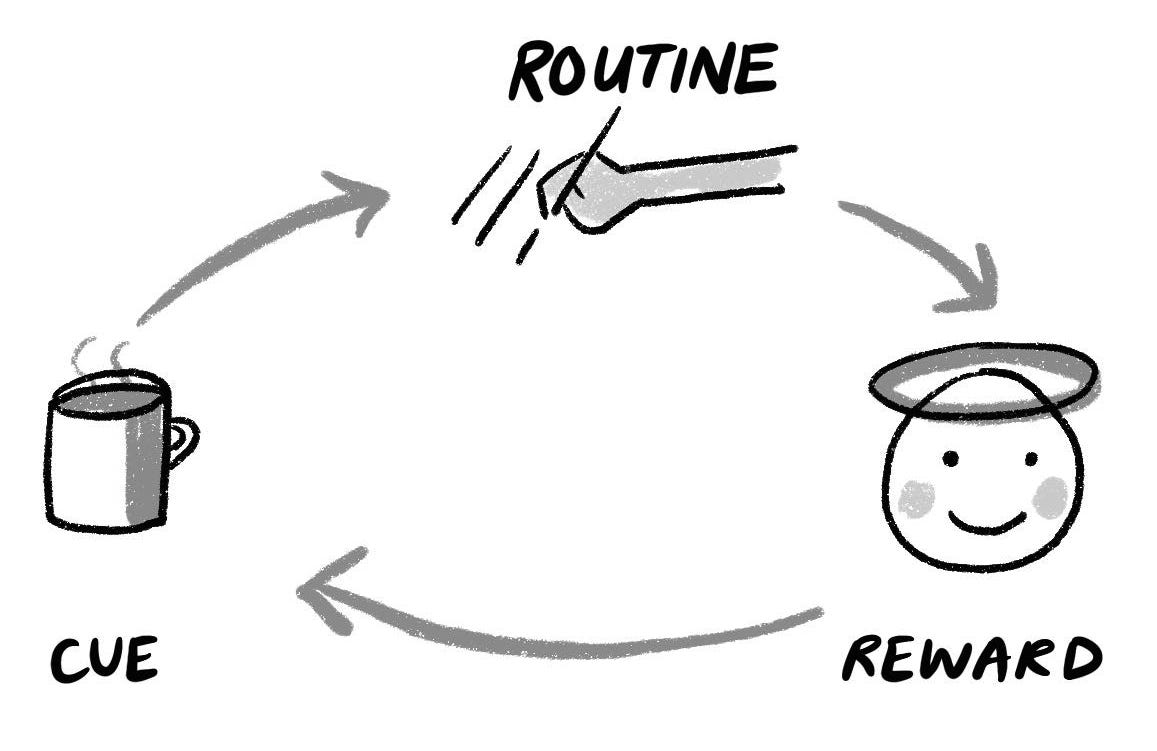
Menmuir said, ‘Coffee will happen at the beginning and then I will have coffee at the end.’ He went on to say, ‘I don’t think I can write without it’.
An existential threat to writers
When Michael Pollan was researching This Is Your Mind on Plants: Opium-Caffeine-Mescaline he ran an experiment to give up coffee. He lists the symptoms of caffeine withdrawal (many of which I experienced) headache, fatigue, lethargy, difficulty concentrating, decreased motivation, irritability, intense distress, loss of confidence and dysphoria. 2
He noted that beneath the ‘deceptively mild rubric of “difficulty concentrating” hides nothing short of an existential threat to the work of the writer. How can you possibly expect to write anything when you can’t concentrate?’
Pollan experienced a fog, what he called a ‘muzziness’, where life was dulled, he was unable to focus, with caffeine-free mornings being the worst.
Coffee or caffeine?
Last summer Menmuir came to visit. The first thing he did on entering our kitchen was admire the coffee machine and grinder. As I brewed a cup for him, he spoke of his latest coffee subscription selection box and of the vintage Gaggia espresso maker he was renovating. I love coffee, but for Wyl it’s a whole other level. That was until last autumn when his doctor advised he should give it up.
Read more of the walk Wyl and I took last summer: A creative diversion
Menmuir was the first person I called after my doctor’s bombshell. I asked how he was coping. After warnings of withdrawal headaches, he explained that it’s not caffeine but ‘coffee’ that’s essential to his writing routine. He said:
‘I’ve got some really fancy decaffeinated beans which I’m grinding and I’m pretending I’m still drinking caffeinated coffee. I think it’s not the caffeine but the ritual of sitting down with a cup of coffee that prepares me to write.’
His cue to write - if coffee, then Scrivener - remains and the habit loop is unbroken.
After my appointment I cut down to one cup a day, the headache was immediate, and the lethargy overwhelming, forcing me into bed after a few hours of concentration each day. I tapered the caffeine adding in decaf ground to the ‘proper’ coffee until all traces were removed. The headaches continued for a month; considering that the advice was to help my migraines, it seemed a high price to pay.
Grind culture
Michael Pollan explores the science of caffeine, what he called ‘the most widely used psychoactive drug in the world’, from its stimulating properties, to the pharmadynamics that are so attuned to the daily rhythm of our lives, and its impact on productivity and creativity. While some of the studies might not be the most rigorous, the consensus is that caffeine improves performance on focus, alertness, attention and learning. It gives us an edge, though has been found to make us ‘faster but not smarter’.
Then there’s its role in fuelling the industrial revolution by helping workers endure long shifts. Perhaps giving up coffee is the antidote to toxic productivity?
One thing that struck me reading Pollan’s work is that while caffeine aids productivity because of its ability to help us focus, this can be counterproductive for creativity which requires a more diffuse form of attention. Our minds on caffeine are efficient workers but less able to play. It reminded me of a study about creativity at ‘non-optimal’ times of day. In short, when we are tired we are better at solving insight problems that require non-linear thinking.3 In our natural decaffeinated state we are more creative, but as Menmuir and I discussed we are very very tired. So, what did it mean for my writing?
Late, less productive, more creative
I had a article deadline partway through my withdrawal. I showed up at my desk each morning, decaf coffee to hand, and I wrote. There was the usual amount of procrastination and anguish about getting the words down and I was late on submitting - something that never happens. That might have been due to the lack of caffeine (not sure the editor would have accepted that as an excuse) but it seems the ‘faster not smarter’ coffee-boost aligns with my experience when it is removed. When it comes to the article, I’m really chuffed with it; the experience felt more creative.
For now, I’m pretending that decaf is sufficient a trigger for my writing routine and trying to accept that I might be slower and more muzzy. Perhaps going cold turkey is the ultimate creativity boost.
I’m back at the doctors next week for my follow up appointment and I’ll be taking my migraine diary with me.4 Perhaps I should take my writing tracker too?
Keep going, Bec
P.S. If you liked this article please consider supporting us by subscribing or upgrading to a paid membership. When you do, you can join our 7-Day Writing Sprints and goal setting webinars across the year.
Alternatively, we’d be grateful for any likes, shares or comments you have.
All of these examples were in our book Written: How to Keep Writing and Build a Habit That Lasts with the original source of Mason Currey’s Daily Rituals
There is an extract from This Is Your Mind On Plants: Opium—Caffeine—Mescaline by Michael Pollan on The Guardian, read: The invisible addiction: is it time to give up caffeine?
Research by Mareike Wieth and Rose Zacks indicates that people are more creative and better at solving insight problems that require ‘outside-the-box’ thinking during their non-optimal time of day, when they are tired or less alert. This is because reduced inhibitory control at these times allows for more creative, non-linear thinking.
Wieth, M. B., & Zacks, R. T. (2011). Time of day effects on problem solving: When the non-optimal is optimal. Thinking & Reasoning, 17(4), 387–401.
I found a use for ChatGPT! I have been tracking migraines on my phone’s notes app for years, and it was so helpful to upload all that data and get AI to analyse it for patterns. I did not ask for medical advice - I’m not that person - but it meant when I went to the doctors I had patterns to explore. It also taught me the word ‘prodrome’ so I could identify symptoms ahead of an actual attack.

I cut out caffeine for health reasons over 30 years ago and after the initial withdrawal symptoms I’ve never looked back. It’ll be worth it!
We switched to decaf around two years ago due to blood pressure (it seems to help) and it works pretty well. Can’t always reliably get decaf when I’m out so I have up to one cup of caf per day, but I don’t generally notice the difference.
In my old job in York, we had a cafetière and a coffee stash and probably made around four or five cups a day for each other - when I moved to Birmingham I realised the frazzled wired state I’d been living in wasn’t solely due to the stress of asset management!