

The shape of writing
A simple way to understand your changing creative process with advice from Beth Kempton & inspiration from Benjamin Myers, Lilly Allen, the founder of the LSE & local authors



Hey there, Bec here
Do you find flow in free writing or in slashing sentences in a much-reworked manuscript?
In the same way that structuring an academic article is different to journaling or writing a to-do list (the ultimate work of fiction), writing takes many different forms. We’ll have preferences for different stages. Some of us love the magic of inspiration and are brimming with ideas, others like to grapple characters onto the page, or even (shudders to think), share our work with an audience.
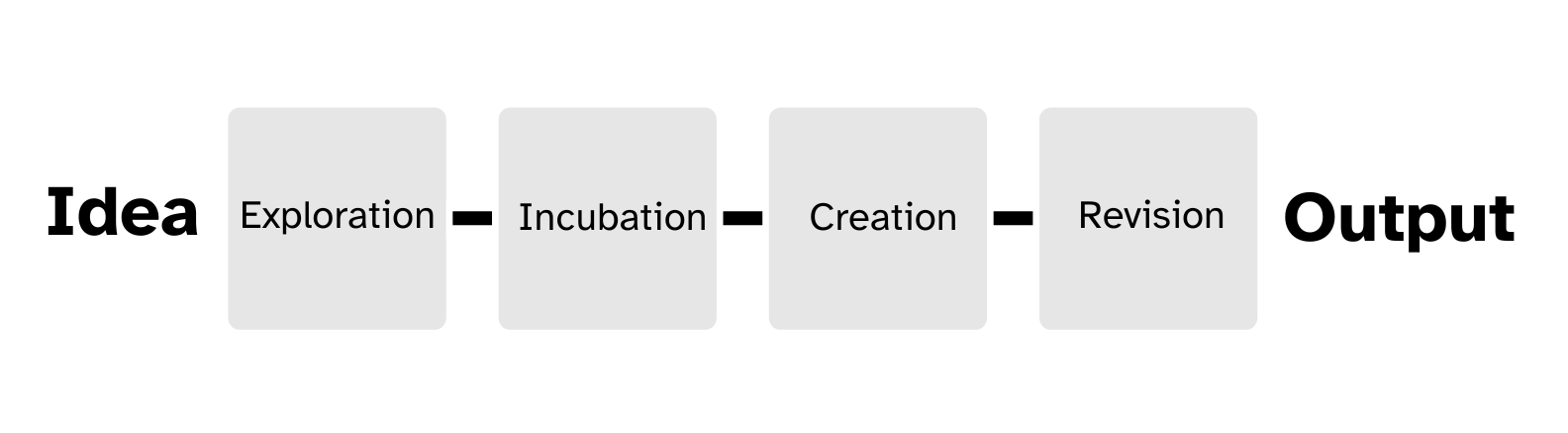
When I describe the stages of creativity, I reduce them to a simple process, moving from exploring inspiration, to incubation where you consider and connect ideas, through to the act of creation as you write them down, and finishing up with revision.
Read more: Picturing the creative process
It’s a helpful starting point for understanding our own process, but it lacks the feeling of creativity and experience of writing. For that I turn to Beth Kempton and my much thumbed copy of The Way of the Fearless Writer.
She has a theory about three states of writing:
“Writing exists in three different states, which mirror the properties of water: the gaseous state, the liquid state and the solid state. When we understand this, and learn to work with each state of writing, we can write without fear the majority of the time.”
- Beth Kempton
Kempton explains each state, beautifully, poetically in her book. I paraphrase:
Gaseous-state writing includes journaling and list writing, a mix of past experience and front-of-mind thoughts, that we capture and process privately.
Liquid-state writing is where ideas takes shape, turning thoughts and intuition into language. It needs to be treated carefully and shared sparingly.
Solid-state writing is the crafting of the written word. Kempton describes how we “whittle, shape, sculpt and polish. We write this way to inform, instruct, educate or tell a story in a way that someone else can take in.” It is written to be read by others.
For her, writing is a formless animate being, a hard-to-capture experience:
We cannot fully describe it, because it does not have a fixed form. All we can really do is be with it, and work with it as it shifts between these various states. We become paralysed by fear when we treat all writing the same, but by acknowledging these different writing states we can confine our various fears to one state or another, not allowing them all to flood our writing all the time.
- Beth Kempton
There’s much I find helpful in her description of writing, especially the idea of how we shift between states.
Last week I was working on the final edits of an article for publication. It had been through seven or eight drafts already, had been read by trusted beta readers and sub-edited, but the conclusion needed reworking. It was by all intents at the last stage of the creative process. It was solid state, fixed, perhaps even frozen; yet to figure out the conclusion I needed to revert to gaseous and liquid state, to discover my original goal for the article. I had to think, explore, and freewrite what I meant, before slowly piecing it together again. I took the solid and evaporated it, and then in containing it, the gas became liquid became solid.
All states matter. Depending on the stage of our writing, we’ll have a different emphasis - and of course, a preference - but to get our writing out to readers we need all three. I’d love to hear what you think of Kempton’s description and if it helps you consider how you write.
“All three states matter, and together they help us to free the mind, open up the channel to write from a deep place, and then prepare that work for sharing with the world.”
Beth Kempton
Thanks for reading, Bec
P.S. If you liked this article please consider supporting us by subscribing or upgrading to a paid membership. When you do, you’ll receive eight 7-Day Writing Sprints and four goal setting webinars across the year.
Alternatively, we’d be grateful for any likes, shares of comments you have.
Incubation period
On creativity: Political thinker and founder of the London School of Economics Graham Wallas set out to apply scientific reasoning to creativity in his 1926 book The Art of Thought. He wrote that in the creation of every work of art there are four successive stages: preparation, incubation, inspiration, and elaboration.
It struck me that the moment of inspiration doesn’t come at the beginning, what we’d often think of as the eureka moment, but at the third stage, after we have prepared and explored ideas.
Is inspiration internal or external? Joyful author Ingrid Fetell Lee’s latest newsletter explored the ‘oceanic state’ of creativity. With roots in Zen Buddhism and other mystical traditions, it has been touched on by contemporary writers like Elizabeth Gilbert in Big Magic and Rick Rubin in The Creative Act. Fetell Lee writes that inspiration is not a personal, internal moment, but “a collective pool from which our consciousness draws inspiration.” Think of artists being antennae, “picking up ideas from a broader source and bringing them into being.”
Audio autofiction. Like everyone, I’m OBSESSED by Lilly Allen’s new album West End Girl - less for the music (I’m not a pop person, though Pussy Palace is perfection) but for her mastery of autofiction. Her ability to meld different forms to tell a story of a relationship through lyrics that include reading text messages, imagining phone calls or listing items in a shopping bag. Past relationships will be picked over, tears shed, anger ignited, and dissertations written about this 44-minute epic.
Experimental hypochondriac writer. I’ve just read Jesus Christ Kinski by Benjamin Myers. The book is a genre-defying experiment mixing memoir, non-fiction and novelistic flair as he inhabits the German actor in his last performance in a much-interrupted, chaotic monologue as Jesus in Berlin in 1971. Being a fan of the writing process I loved the middle section, called ‘intermission’, where Myers shares his hypochondriac state of writing, sitting in the same snowbound valley I live in - on the dark side, where the sun never reaches. It is now my favourite writing autobiography ever. Though Myers would hate me to call it that!
Local authors. I hosted a panel at the Todmorden Books Festival at the weekend. This is one of the best parts of my job, though a rare delight. I adored talking to composer and novelist Kerry Andrew about We Are Together Because and Rozie Kelly about her debut novel Kingfisher. The audience was buzzing, we sold all the books, and everyone stayed long after to keep chatting. I got to hang out with some of my writing besties including Liz Flanagan and together we celebrated Katherine Clements launch her new novella Turbine 34.
Reminder! Support your local bookshop, authors and events - you’ll be surprised how much great writing happens on your doorstep.

Bec, thank you for this introduction to Beth Kempton and her stages of writing theory. It's been hugely helpful.
As you may remember, I'm a big fan of the gaseous part and the solid part, not so much the liquid.
Working on my current piece a few days ago, I was getting increasingly frustrated and unhappy with the shapeless mass that had somehow evolved from my brilliant idea.
What a relief to realize that I was just adrift in the liquid state, that the incoherence wasn't my personal failure, but instead a part of the process. No need to dive into "I'm a lousy writer, a failure, incapable of thinking my way through a simple essay."
Next morning a question popped into my mind that, fingers crossed, will provide a strong focus that lets me make sense of it all.
Without you I might still be flagellating. Thanks again.
I am finding it so true that writing is not linear and I move back and forth between different states seemingly quite randomly. I love Beth’s description of the three states, and it has reminded me to pick up her Fearless writer book which I started but haven’t finished x